Trust the exposed god
One statue enters the hall already exposed: a feather means every oath it swears is true, a struck feather means every one is a lie. That single certainty is the thread you pull.
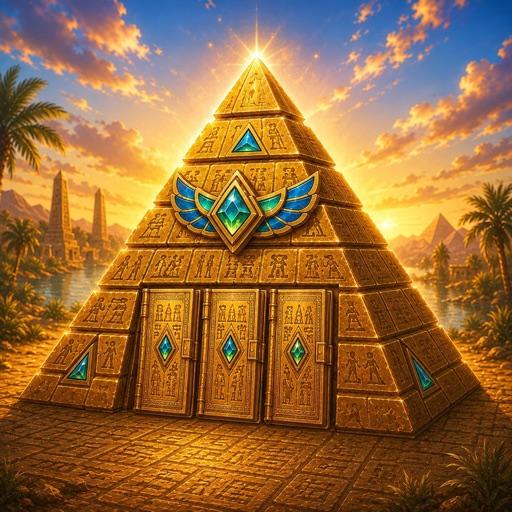 Glyph Oath
Five gods stand in a sealed hall. Each swears an oath in pictograms — and half of them lie about everything. Exactly one door is the clear passage down. Work out which one before the sand runs out.
Anubis is exposed with a struck feather — every word he swears is a lie.
He swears door 2 is not the way down. So door 2 is exactly the way down.
Clear passage. Depth 4.
No timers to fight, no reflexes to train. Every hall is a small proof, and the tomb never builds one you cannot finish.
One statue enters the hall already exposed: a feather means every oath it swears is true, a struck feather means every one is a lie. That single certainty is the thread you pull.
Tap a statue and its oath is spelled out on the plate below. There are only eight kinds of oath in the whole game, and they are all drawn, never written.
Tap a door to cycle your own mark — blank, safe, danger. The scribe keeps your marks so you can reason across a whole hall without holding it all in your head.
Press and hold the door you believe in until the ring fills. Stairs take you deeper. A scorpion costs a torch, a cave-in ends the descent — and every mistake exposes one more god forever.
This is the entire vocabulary of the tomb. Learn these eight strips and you can read every hall in the game — in any language, at any age.
Door 2 hides a scorpion.
Door 3 does not hide the clear passage.
Thoth always deceives.
Anubis always keeps faith.
At least one of doors 1 and 3 is the clear passage.
Doors 2 and 3 both hide a scorpion or a cave-in.
The clear passage stands to the left of door 3.
If door 1 is the clear passage, then Horus keeps faith.
The last two oaths only appear in the second and third tomb.
Everything below the puzzle exists for one reason: to make a wrong door hurt and a clean read feel earned.
Three torches go down with you. A wrong door costs one, and so does letting the hourglass turn. When the last flame dies the descent is over and you climb out with what you carried.
Clear three halls in a row on the first try and every scarab doubles. Six in a row and they triple. One mistake, one turned hourglass, and the chain is gone.
The Eye of Horus reveals what one door hides. The Amulet of Thoth forces a statue to show its nature. The Mirror of Hathor relights the torch your last mistake took.
Every three depths earn an attempt at three questions on ancient Egypt. Right answers pay scarabs; a perfect three opens a chest of lapis.
Open a treasure and the scribe brings his balance. Match the offering's weight in hieratic numerals — a stroke is one, a heel ten, a coil a hundred, a lotus a thousand — and the hoard doubles.
Three fresh tasks every day, a streak to keep, and a sanctum where scarabs buy more torches, more sand and a scribe who does more of the bookkeeping for you.
Each tomb adds one new idea and never takes it away. Plus an Endless Descent that keeps going until your last torch does.
Three doors, two statues, and the oaths arrive one kind at a time. Nothing is thrown at you until you have used the last thing.
Adds the left-of oath and mute statues that only take up a slot — a god who says nothing tells you nothing, and the sand no longer waits.
Adds conditional oaths, and one door wears the jaws. Open that one and it takes two torches instead of one.
Every layout is checked by a solver before you see it. If the oaths and the exposed statue do not point at exactly one door, the hall is thrown away and built again. You never lose to a guess the tomb forced on you.
Bugs, a hall that looks wrong, an idea for a ninth oath — all of it is read by the person who built the game.